The group arrives at the owlbear den to discover that the family of owlbears they are to transport is in the middle of a conflict with another pair of owlbears. The player characters need to resolve this conflict before they can prepare the owlbears for transport.
Supplemental Information: The following information is useful for running this stage of the adventure.
- Owlbear Den Encounter Map
- Owlbear Token
- Owlbear Creature Description
- Audio of Owlbear Fight with Warning Calls
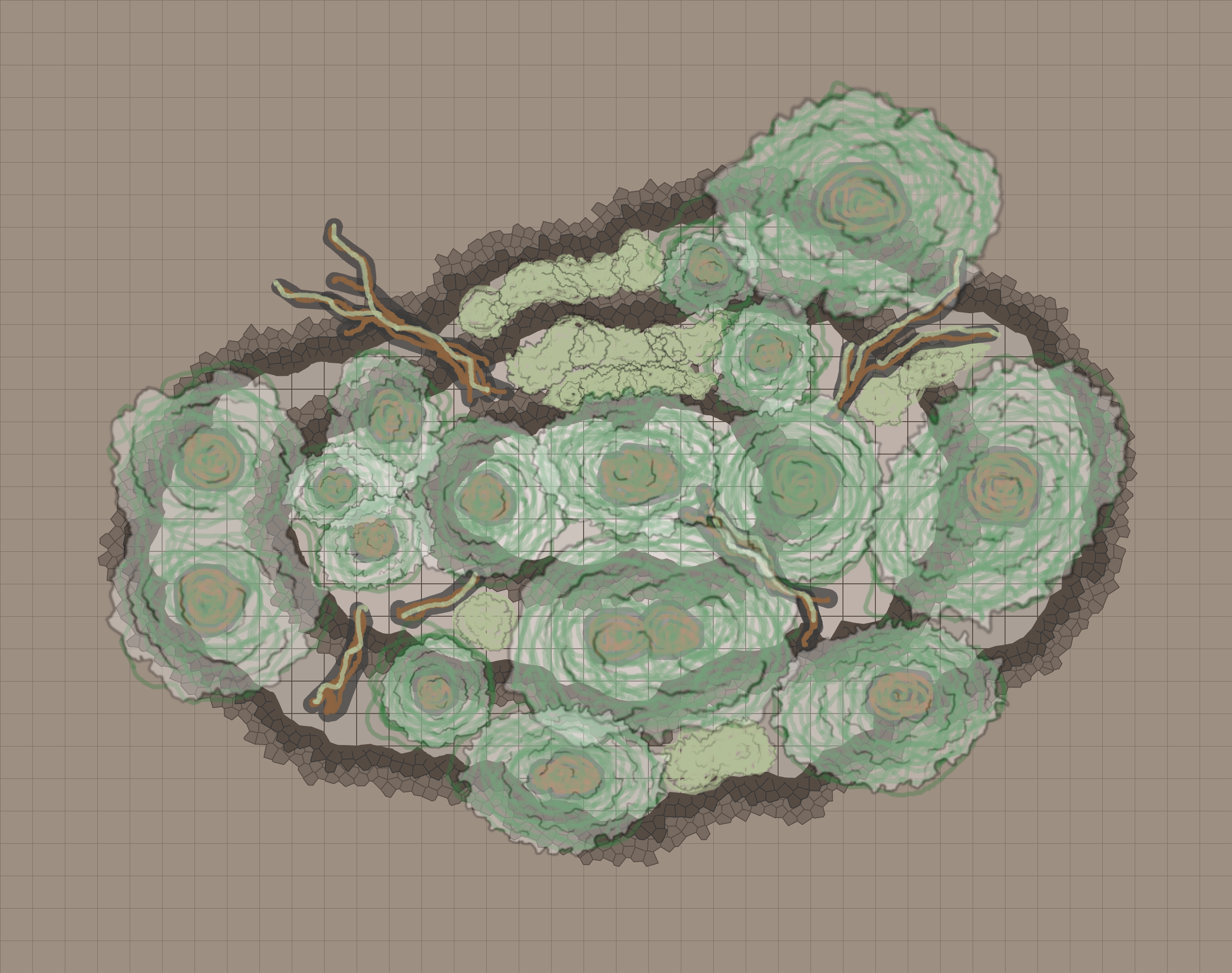
Reading the Owlbear Den Encounter Map: The elevation lines, standing trees, and downed trees marked on this map the same way they were marked on the Briar Creek map for Stage 4.
- Thickets: Particularly dense thickets of bushes are marked by pale-green, shaggy, squiggles that don’t have trunks in the middle.
- The Den Site: The owlbear den site is marked by a partially obscured dip in the highest (smallest) elevation ring. The largest clump of bushes is obscuring the opening.
Owlbears: The player characters are here to collect a specific pair of owlbears, along with their two eggs. We will be calling them the defending owlbears in this section.
- Appearance: Owlbears look like large bears with owl heads. Most of their body is covered in fur. They have brown feathers on their heads, in a crest that runs along their spine, and band of feathers that goes around their bellies and hips, much like a feathery tutu. They have massive hooked beaks and large paws with powerful claws.
- Behavior: Owlbear behavior is a combination of bird and bear behavior. Like owls, they pair bond, lay eggs, and raise nestlings together. Like bears, they react aggressively when someone gets between them and food, when startled, or when protecting their young. When upset, owlbears stand up on their hind legs, puff up all their feathers, and screech threateningly. Owlbears can attack with both claws and beaks.
- Attacks: When an owlbear attacks a player character, the player must roll their character’s physical defense. Failures (zero successes) will result in an injury.
- Magic Resistance: Anytime magic would directly affect an owlbear, roll a six-sided die. If the result is a 4, 5, or 6, the magic has no effect on them. This happens regardless of whether the magic is harmful or beneficial.
The Owlbear Fight
Starting Parameters: The group’s condition at the start of this encounter is determined by how much they recovered at the end of the will-o’-wisp encounter.
- For those using the encounter map, the player characters will start at the bottom of the map (horizontally centered).
Description: “According to the map, your group is now quite close to the owlbear den. There is a small hill in front of you. The den should be in a cave on the opposite side of that hill. What are each of you doing as you approach the hill?”
- This is where the players have a chance to establish where their characters are before everything starts. If their plan takes too long, consider interrupting them with the beginning of the owlbear fight.
What Is Happening (the Players Need to Figure this Out): A more established, male-male bonded pair of owlbears arrives at the den. This marauding owlbear pair has no eggs of their own and they are here to steal the eggs from the defending pair in order to raise the babies themselves. When the male-male pair arrives, only one of the defending owlbears is guarding the den.
The defending owlbear immediately raises the alarm and his mate rushes back to help defend their eggs. However, the defending owlbear is outnumbered long enough that, if nothing is done, the marauding pair will steal one of the eggs.
Round #1: The marauding owlbears attack and the defending owlbear raises the alarm.
- Description: “A series of harsh shrieks ring out. They sound a lot like the warning call birds make when they spot intruders close to their nest. These calls are quickly followed by loud crashing in the underbrush.”
- This is the moment to play the audio clip of the owlbear fight.
- What do each of the player characters do?
- Figuring Out What Is Happening: The characters will come upon this scene without knowing what is going on. Perception, Communicating with Animals, and Nature can all give different types of insight into what is happening.
- Partial Successes: The second defending owlbear is rapidly approaching. Characters that get partial successes on their actions might be distracted by “the sound of something large moving rapidly through the bushes toward the fighting owlbears.”
- Failures: A failed roll could be caused by the rapidly approaching owlbear coming right at the character, interrupting their action. If appropriate, the owlbear mistakes them for the threat and will attack next round.
- Magical Consequences: Failed or partially successful magic rolls could turn someone into an owlbear or one of their favorite prey species, such as a zombie.
- Without Intervention: The two marauding owlbears will corner the defending owlbear outside of the den, clearing the way for one of them to intrude into the nest.
Round #2: The second defender arrives as one of the marauding owlbears grabs an egg.
- New Arrival: This round starts with the second defending owlbear rushing up to protect their eggs. If one or more of the player characters is hanging back from the fight, this owlbear will go right past them, possibly mistaking them for a threat and attacking (especially if someone rolled a failure the previous round).
- What do the player characters do?
- Without Intervention: One of the marauding owlbears will go inside the den and carefully pick up one of the eggs in his beak.
Round #3: If the marauding owlbears have captured an egg, they leave with it. If not, they make one more attempt to get an egg.
- Without Intervention: The newly arrived defending owlbear (if not distracted by the player characters) crashes into the fight and the two marauding owlbears run off with the egg they have stolen.
- What do the player characters do?
Transporting the Owlbears
Once the owlbear conflict is resolved, the characters can implement their plan for moving the owlbear pair and their eggs. The outcome of the previous conflict will have a huge impact on how the two defending owlbears react to the player characters.
- Successful Defense: If the player characters successfully helped the owlbears defend their eggs, they will be prepared on all social skill rolls to interact with them for the rest of the day.
- Failed Defense: If an egg was stolen, the owlbears are so distressed that the player characters will take a one die penalty to any interaction that does not involve rescuing their egg.
- Perceived Threat: The owlbears will attack anyone they perceive as a threat to their eggs. Failed rolls to interact with the owlbears are likely to result in the owlbears perceiving someone as a threat and immediately attacking.
Negotiation: Characters that can speak to animals can attempt to negotiate with the owlbears. Whether or not an egg has been stolen will shape the owlbears’ priorities for this negotiation.
- Stolen Egg: The distraught parents will demand their egg’s return. Offering this will make the player characters prepared on their roll. Failing to offer this will cause a one die penalty.
- Both Eggs Are Safe: The owlbears will be the most motivated by gifts of food and offers of a safer den site and better hunting grounds. Offering any of these three things will make the player characters prepared on their social skill roll.
Find the rest of the Owlbear Reintroduction Program Adventure here.