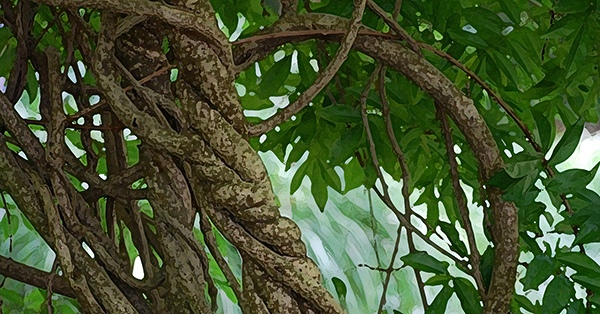
An artwork showing the woody trunks of vines twisted and entwined together. This is meant to illustrate the way individual vines might twist together to form a Vine Collective’s body.
Overview: Vine collectives are a sapient, magical, plant species, meaning that they are capable of complex thought. Each individual is a group of animated vines that entwine together to form a shared humanoid body and consciousness.
Physical Description: Each vine collective is a group of entwined vines joined together by a shared root system. The vines are unbranching and weave together to form a roughly humanoid body covered in leaves. Each foot of this body is an interconnected root web that allows the vines to share water, food, and nutrients with each other. New shoots start in these root webs and grow quickly because they are nurtured by the adult vines.
In order for a vine collective’s roots to get water and nutrients from soil or mud, the ends of their roots temporarily extend out of the root web and sink down into the ground. Vine collective roots can pull in water and nutrients quickly and store them in the base of the vine stems, allowing the collective to retract their roots and move on after only a short time of being rooted. As a result, their humanoid bodies tend to have big feet, thick legs, and a low center of gravity that makes them difficult to knock over.
Different vines in each collective perform specific tasks. At a minimum, most vine collectives have woody structure vines that hold the other vines up, leafy energy vines that photosynthesize food, and delicate sensory vines with organs that let the vine collective perceive the world around them.
Many vine collectives also have armor vines that form a tough, armor-like shell. Others have thorn vines that protect with rows of needle-sharp thorns. Yet others are without defensive vines, protecting themselves with their greater flexibility and ability to fit into tight spaces.
Because vine collectives are so magical, there are many other individual variations. For example, some collectives have vines that protect them from extreme weather, store food for the winter, repel insects, or that attract and devour insects.
The majority of vine collectives can reweave their vines to take best advantage of their different vine functions. For example, when they are in bright light, they can reweave to extend the leaves of their energy vines. Then, if a threat approaches, they can reweave so that everything is protected underneath their armor vines.
Gender: Just like other sapient plant species, most vine collectives identify as nonbinary and use they/them pronouns. Of course, there is always gender diversity and some vine collectives have binary genders or specific non-binary genders, like being agender or genderqueer.
Senses: The abilities of each vine collective’s sensory vines vary from individual to individual.
Diet: Vine collectives get energy from photosynthesis and need a significant amount of time in the sun every day. Water and nutrients are absorbed through their roots as described above. Because vine collectives can store energy, water, and nutrients in the base of their stems, most can go a few days without sun, water, or nutrients.
Common Mental Characteristics: The consciousness of each individual vine in a vine collective joins with the others to form a collective consciousness. Usually this connection is facilitated by telepathy. The degree to which individual vine consciousnesses are subsumed into a vine collective’s group consciousness varies. Some vine collectives experience themselves as a single entity, but others experience themselves as a group of consciousness.
Magical Affinities:
- Plant Magic
- Earth Magic
- Water Magic
- Fire Magic, especially manipulating light
- Weather Magic
- Communication Magic
- In Tune with Nature
Common Species Traits:
- Telepathy
- Plant Talker
- Permanent Defense from armor or thorn vines
- Malleable Form
- Built-in Tool
- Immunity to Being Knocked Over or Lifted Off the Ground
- Regeneration
- Magical Nature
Common Vulnerabilities:
- Cold Sensitivity
- Moisture Requirement for those that have leaves that dry out easily
- Specific Damage Vulnerability to freezing or fire
- Sharp Exterior for those with thorn vines, especially if those vines don’t retract
- Dietary Restriction for those that have to spend at least half of each day in sunlight
- Sinks like a Stone for those with dense stems
- Noisy Form for those that make a lot of sound when they move
- Intense Sleepiness for those that struggle to function at night
- Sunlight Reactive Body for those with the large, easily-burned leaves of a shade plant, especially if those leaves don’t retract
- Water Absorbent Body for those desert-adapted vine collectives that can’t stop absorbing water
History: The first vine collectives were created by the chaotic magic of a warped magic zone that was located inside a tropical rainforest. In the competitive rainforest environment, being able to move to get nutrients and sunlight was a major advantage for them and they thrived. After a period of magical development, vine collectives were able to leave the warped magic zone to spread out over Crossroads, some adapting to different environments.
Prominent Cultures: Because each individual is a collective, communities that have many vine collectives in them tend toward a collective mindset. Also, being mobile sapient plants, the resources they need, like sunlight, are easily shared. As a result, these communities tend to value sharing, generosity, and cooperation.
Even though some vine collectives have adapted to deserts, their origins in a tropical rainforest makes many vine collectives sensitive to both cold and dryness. As a result, the majority of vine collectives live in wet areas with a warm or mild climate. Only a few travel to places with extreme cold or dryness, and fewer live there. It is similar for dark locations, such as caves. There are a few intrepid vine collectives who brave these conditions using magic or specialized gear, but the majority stick to more favorable environments.
Outside of protective gear for harsh conditions, vine collectives rarely wear clothing, as it interferes with photosynthesis. However, because of the importance of the root webs in their feet, many do wear sandals, boots, or other foot protection. In addition, some vine collectives wear jewelry, ribbons, or small pieces of fabric for ornamentation.
Inspiration: The ways that plant siblings in some species share resources and grow together. The way that cells divide and develop into different types of tissue. Superorganisms formed by social insects.
Respectful Portrayal Note: As a fictional being made up of multiple consciousnesses joined together, some portrayals of Vine Collectives may be associated with Dissociative Identity Disorder (DID). If you don’t have lived experience with DID, please take care when portraying anything associated with this much stigmatized condition and do the research needed to avoid myths and stereotypes.
Vine Collectives are part of the Crossroads Setting for the tabletop role-playing game, Magic Goes Awry. Click here to go to the list of vibrant and unique magical people from the Land of Crossroads.