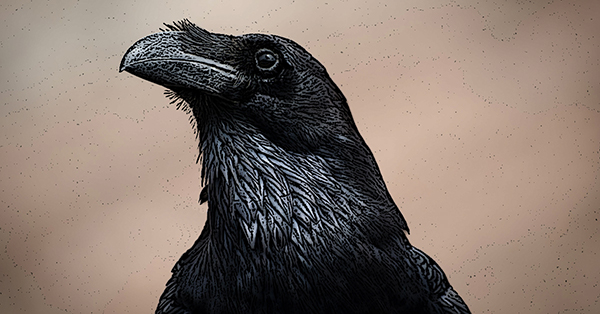
Portrait of a raven with their head up in an alert posture. They have the left side of their face turned toward the viewer and their beady, black eye is watchful. This artwork is a modified photograph by mgabor.
Sapient Pronunciation: SAY-pee-uhnt
Overview: Sapient Animals are highly magical beings with the bodies of animals and minds capable of human-like thought. Most Sapient Animals have a trait that clearly marks them as magical.
Physical Description: Sapient Animals can be any type of animal, though the majority of sapient animals are medium or large. Most Sapient Animals are also vertebrates (animals with skeletons), though there are a few important exceptions, like Sapient Crabs and Sapient Octopuses.
Most Sapient Animals have one visible or audible trait that marks them as magical. For example, they may have glowing eyes, hooves that spark, fur that is an unnatural color, a forked tail, trailing shadows, a feature from a different type of animal, feathers that make delicate chiming sounds, or scales patterned with runes. Outside of this trait, and a mind capable of human-like thought, Sapient Animals are indistinguishable from non-magical animals.
Because their bodies are infused with magic, many Sapient Animals have additional magical traits, such as telepathy, regeneration, and magical flight. Like these three examples, many of these additional traits are abilities that aren’t apparent until they are used. These magical abilities can be quite dramatic, such as a Sapient Elephant with a magically malleable body that is able to squeeze through a six-inch gap.
Gender: Sapient Animals have the same kind of broad gender diversity as non-magical animals. The animal world is full of gender diversity. For example, many species exist outside of the two-sex binary, including species with one sex, species with three or more sexes, and species that can change sex. There is also diversity in animal gender expression, sexuality, kinship, and family structure.
Senses: The majority of Sapient Animals have the expected senses for an animal of their type, this include some with sensory disabilities. A few have magically enhanced senses or an additional sense.
Diet: Most Sapient Animals need to eat the kind of food appropriate for an animal of their type.
Common Mental Characteristics: Sapient Animals have minds capable of human-like thought. This means that they can understand, problem-solve, and communicate with as much depth and complexity as an average human. How much of their animal nature, instincts, and communication patterns a Sapient Animal has depends on which population they are from and also varies from person to person.
Magical Affinities:
- Animal Magic
- Enhancement Magic
- Air Magic: For flying Sapient Animals
- Water Magic: For aquatic and semiaquatic Sapient Animals
- Earth Magic: For burrowing Sapient Animals
- Plant Magic: For Sapient Animals that have especially close associations with plants
- Sensing Magic: For Sapient Animals with particularly keen senses
- Sapient Animals can also have animal specific affinities, such as Attention Magic for Sapient Peacocks and Communication Magic for Sapient Parrots
Common Species Traits: Some species traits come from the inherent capabilities of a Sapient Animal’s body. Other species traits are magical traits that some Sapient Animals gain from their inherent magic.
- Animal Traits: Skill Aptitude for Climbing, Swimming, or Flying based on their physical traits, Heightened Senses, Additional Sense, Amphibious, Unhurt by Falls, Malleable Form (for flexible animals like octopi), Permanent Defense, Flight (using wings), Additional Limbs, and Built-in Tool.
- Magical Traits: Telepathy, Enchanting Song, Immunity, Magical Nature, Malleable Form (for animals that don’t have malleable bodies), Tiny Form, Huge Form, Regeneration, Flight (without wings), Plant Talker, Animal Talker, Shadow-touched, and Incorporeal Form.
Common Vulnerabilities: Just like species traits, some vulnerabilities come from the limitations of a Sapient Animal’s body, while others are due to their inherent magic.
- Animal Vulnerabilities: Noisy Form (mundane causes), Moisture Requirement, Sinks like a Stone, Cold Sensitivity, Heat Sensitivity, Dietary Restriction, Sharp Exterior, Poisonous Exterior, Limited Object Manipulation, Easily Fatigued Body, Intense Sleepiness, Sensory Sensitivity, and Light Sensitive Eyes.
- Magical Vulnerabilities: Permanent Glow, Noisy Form (magical causes), Emotionally Reactive Magic, Danger Amplification, and Specific Damage Vulnerability.
A Few Interesting Facts:
- The Sapient Animals of Crossroads includes animals that are extinct in other places, such as Sapient Dinosaurs.
- Because having an unusual feature, like a forked tail, is something people use to recognize Sapient Animals, ordinary animals with unusual features are sometimes misidentified as Sapient Animals.
- When traveling in wild and semi-wild places, many Sapient Animals wear large, flamboyant accessories to intimidate predators and ensure their sapience is recognized by any sapient hunters.
Origins: Most Sapient Animals originated as non-magical animals in Warped Magic Zones. In multiple different events at different times and places, a wave of Mind Magic reshaped these non-magical animals into groups of highly magical Sapient Animals. Over the years, this process has produced a diverse and sizeable Sapient Animal population.
Prominent Cultures: Living in a group, like a flock, herd, pod, pack, or pride, is important to the majority of Sapient Animals. Some of these Sapient Animals live in a group with other Sapient Animals of the same type, such as a flock of Sapient Crows, or with Shifters and Animal-Folk that are the same type of animal, such as a pack of Sapient Wolves, Wolf Shifters, and Wolf-Folk. It is also common for Sapient Animals to live in diverse groups with widely differing types of Sapient Animals. The culture of each of these groups depends on the nature, instincts, and communication patterns of the main animal or animals in it, as well as that of other nearby groups.
While living in a group, or at least a family, is important to most Sapient Animals, there are some who prefer to live on their own. Most of these find ways to live independently on the periphery of a community. This is mostly due to the many benefits that come with living near a community, but is also partly due to the fact that Crossroads is land full of people—there just aren’t that many places where people can live in complete isolation.
Clothing and Equipment: Most Sapient Animals find it easiest to live in the environments their bodies are adapted for. While this works well for those Sapient Animals that naturally have wide ranges, like Sapient Cougars, Sapient Rats, and Sapient Barn Owls, it can be more difficult for Sapient Animals with more specialized adaptations, like Sapient Camels, Sapient Snowshoe Hairs, and Sapient Toucans.
Just as humans use clothing and equipment to adapt to a wide range of environments, Sapient Animals with specialized adaptations can use protective clothing and equipment to live in a wider range of environments. In addition, Sapient Animals with even the most versatile of adaptations will need clothing and equipment to travel within extreme environments they aren’t adapted for.
The big challenge with Sapient Animals using clothing and equipment is that most don’t have hands. Those Sapient Animals that live in groups get around this by working together to use equipment and put on clothing. Those who live independently use a combination of assistive devices, magic, and creative uses of their skills and abilities. A few have service animals that help them.
Sapient Animals are part of the Crossroads Setting for the tabletop role-playing game, Magic Goes Awry. Click here to go to the list of vibrant and unique magical people from the Land of Crossroads.