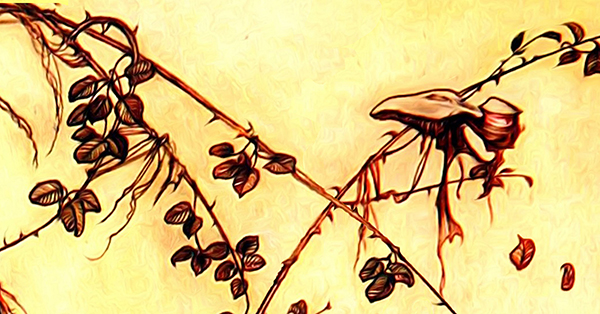
This is a fairy tale-style illustration of three red-brown briar canes against a gold background. One of the canes is piercing a large, gory bird skull, while another has ripped thread or hair tangled around it. This is a heavily modified version of a public domain illustration by Arthur Rackham.
Safety Rating: Extremely dangerous.
Environment: Temperate forests and grasslands. Razor briar sometimes also grows on desert river banks.
Details: Razor briar is a prickly shrub that uses Earth Magic to grow razor-sharp metal, stone, or glass blades on its stems and the undersides of its leaves. The material each patch of briar uses for its blades is based on what minerals are available in the soil. These blades can be up to an inch long and deter non-magical animals from eating razor briar. The blades also shred non-magical plants that get too close, reducing competition.
Razor briar likes moist, well-draining, mineral-rich soils and grows particularly well on river banks. It is also drought tolerant, storing water in its canes and extensive root system, which allows it to go in a wide range of temperate habitats.
Similar to a blackberry, razor briar grows hexagonal canes with hand-shaped clusters of oval leaflets. Each leaflet has a serrated edge and pointed tip. The canes can be up to thirty feet long and thirteen feet high and have a distinct scarlet stripe that runs down their length.
Because growing its blades is time-consuming, unless it is assisted by abundant Earth or Plant Magic, razor briar is slow growing. It can take a decade to grow what similar non-magical species can grow in a single year. While growing so slowly would be a problem for other plants, being able to literally shred the competition means that there is no risk of razor briar being crowded out.
Beneficial Relationships: Razor briar has beneficial relationships with many of the animals and plants that are able to avoid its thorns. Bees pollinate its welcoming flowers and the stems of its berries are blade-free to encourage rodents and small birds and to eat them and spread its seeds. Many of these rodents and small birds also make their homes in the shelter of razor briar thickets, along with well-armored magical animals.
In addition, both will-o’-wisps and vampire vines use razor vine thickets to trap and harm their prey. Once these predators have drained the life from their prey, they leave the corpses to fertilize the razor briar thicket, providing more of the minerals that razor briar needs to grow.
Inspiration: Fairy tales about deadly briars, real-world blackberries, and barbed wire. Biological details, such as the ecosystems they grow in, are inspired by Himalayan blackberry.
Razor Briar Mechanics
Knowledge Rolls: Identifying Razor Briar is a Nature roll.
- 0 Successes: If the character is trained in Nature, a failure means that something else grabs their attention. If the character isn’t trained in Nature, a failure means that this looks like an ordinary blackberry bush to them.
- 1 Success: A partial success means the character identifies this as razor briar, which is an extremely dangerous magical plant.
- 2 Successes: A full success means the character also knows that armor is the best defense against razor briar, while dodging is impossible inside the confines of a razor briar patch.
- 3 Successes: An outstanding success means that the character knows an additional useful thing. For example, if this patch of razor briar also has vampire vines, then the character knows that vampire vines often live near razor briar and gets to immediately check for them. Another option is for the character to use their knowledge that the flowers and berries don’t have blades to find a less dangerous path that will make everyone in their group prepared on their defense rolls.
Razor Briar Patches: If you are working with a map, divide the razor briar up into patches. Each patch requires a separate dice roll to move safely through it.
Defense Rolls: Moving through a patch of razor briar without injury requires a physical defense roll. The type of physical defense a character uses has a big impact on this roll, as does the size of the character.
- Armor: Characters wearing armor get a die for being prepared.
- Shield: Characters using a shield roll normally, without bonuses or penalties.
- Dodging: Because dodging is not possible within a razor briar patch, characters that use dodging for defense don’t get the die for being trained.
- Tiny Characters: Tiny characters have more room to maneuver, so they get a die for being prepared. A tiny character is a humanoid that is at most six inches tall, or a four-legged character that is no more than eight inches long (the size of a rat).
- Giant Characters: Giant characters are so big that razor briar’s blades don’t cause as much harm, making them prepared on their defense roll. A giant character is a humanoid that is at least twelve feet tall, or a four-legged character that is at least six feet tall at the shoulder (the size of a Clysdale horse).
The results of this physical defense roll determine how fast the character can move through the razor briar patch and whether they become injured.
- 0 Successes: A failure means that the character becomes injured. In most cases, a failure also means that the character can only move slowly through the razor briar.
- 1 Success: A partial success means that getting through without injury takes time. The character must choose between getting injured by going quickly and staying safe by going slow.
- 2 Successes: A full success means that character is able to get through this patch of razor briar quickly without injury.
- 3 Successes: An outstanding success means that the character does so well at defending against harm that they move through the patch quickly and are able to assist another character that is struggling. Treat this as if this character with the outstanding success is giving one additional success to the struggling character’s roll. For example, if the struggling character started with zero successes (a failure), they now have one success (a partial success). Similarly, if the struggling character started with one success (a partial success), they now have two successes (a full success).
Making Pathways: In addition to being dangerous, it takes a lot of effort to make a pathway through a patch of razor briar. Anyone doing this work by hand will also go through a lot of tools. Razor briar is known for destroying non-magical tools. However, because razor briar is slow growing, once a pathway is made, it lasts a long time.
Razor Briar is part of the Crossroads Setting for the tabletop role-playing game, Magic Goes Awry. Click here to go to the list of strange and whimsical magical plants from the Land of Crossroads.



[…] Razor Briar Plant Description […]